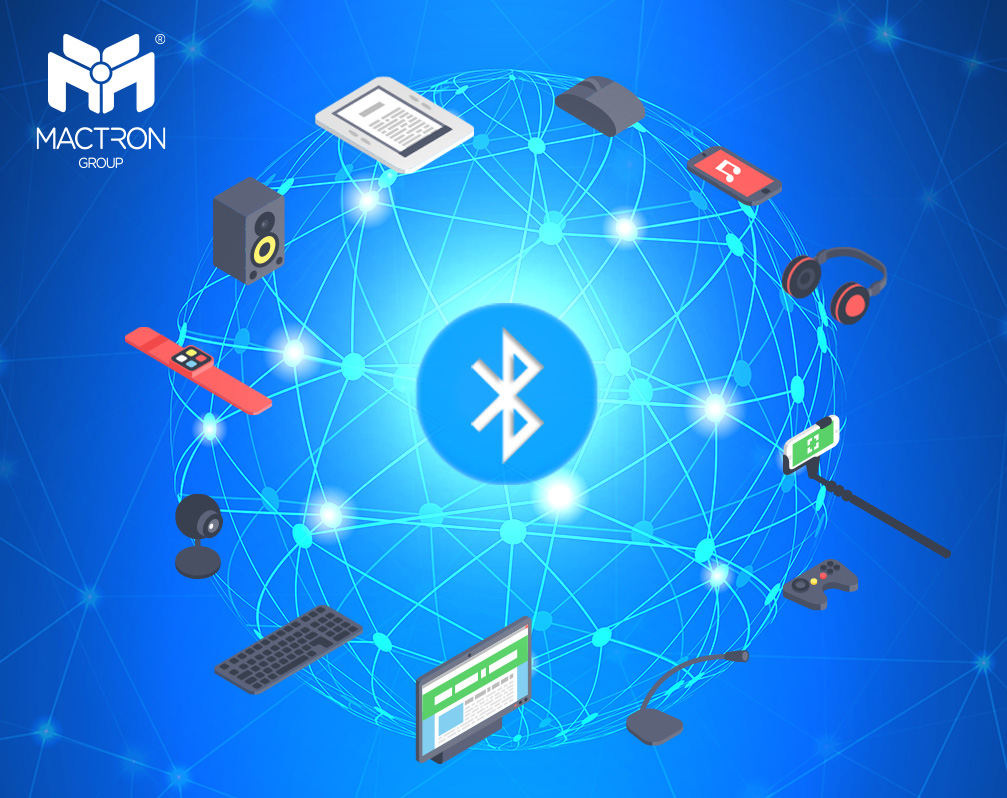
Fundamentals and Evolution of Bluetooth Technology
Bluetooth is a short-range wireless communication technology
primarily used for data transmission and connectivity between
digital devices. It was developed by an organization called the
Bluetooth Special Interest Group (SIG), which includes companies
from various industries.
The Main Features of Bluetooth:
Bluetooth technology is continually evolving, with each new
version introducing improvements and new features.
-
Short-Range Communication:
Bluetooth technology is designed for short-range
communication, typically within a range of 10 meters
(approximately 33 feet). Some versions of Bluetooth can
achieve longer communication ranges.
-
Low Power Consumption:
Bluetooth technology is designed for low-power communication,
making it suitable for mobile devices such as smartphones,
tablets, wearable devices, and other Internet of Things (IoT)
devices.
-
Data Transmission:
Bluetooth can be used to transmit various types of data,
including audio, images, documents, and other multimedia
content.
-
Multi-Device Connectivity:
Bluetooth technology supports simultaneous connections to
multiple devices. This multi-device connectivity makes
Bluetooth very useful in a multi-device environment.
-
Versatility:
Bluetooth is a universal standard widely applied in various
devices, including headphones, audio devices, keyboards, mice,
printers, in-car systems, and more.
-
Security:
Bluetooth technology has certain security features, including
encryption and authentication mechanisms, to ensure the
security of communication.
The Bluetooth Version History:
The progression of Bluetooth technology continues to advance, and
future versions may bring further improvements. The application
scope of Bluetooth technology is expanding from traditional audio
and data transmission to areas such as the Internet of Things,
automotive systems, and smart homes.
Bluetooth technology undergoes continuous updates, with Bluetooth
5.4 being the latest version, while previous versions include
Bluetooth 5.0, Bluetooth 4.2, Bluetooth 4.0, and so on.
Bluetooth 5.0:
Launched in 2016, it provided a longer range, faster data transfer
rates, and improved connection density. It also introduced Mesh
network support, allowing Bluetooth devices to form large
networks.
Bluetooth 5.1:
Released in 2019, it introduced directional Bluetooth signals,
improving the accuracy of location positioning.
Bluetooth 5.2:
Also released in 2019, it introduced LE Audio, providing better
audio performance and multi-stream audio capabilities.
Bluetooth 5.3:
Released in 2020, it further improved positioning technology and
range.
Bluetooth 5.4:
Released in 2023, facilitating secure bidirectional communication
between wireless Access Points (AP) and ultra-low-power terminal
nodes.
The Most Widely Adopted Bluetooth 5.0

-
Maturity and Adoption:
Bluetooth 5.0 is a relatively mature and widely deployed
technology that has found applications in various devices,
including smartphones, headphones, and speakers. This
widespread adoption may make Bluetooth 5.0 more readily
accepted, given its established presence in the market.
-
Compatibility:
Bluetooth 5.0 has higher compatibility relative to earlier
versions, seamlessly working with older Bluetooth devices.
This is an advantage in scenarios where a variety of different
Bluetooth devices are in use.
-
Cost:
Generally, the hardware and related devices for Bluetooth 5.0
may be more cost-effective. If cost is a significant
consideration, Bluetooth 5.0 could be a more practical choice.
-
Application Support:
Currently, many applications and devices predominantly support
Bluetooth 5.0, and the support for Bluetooth 5.3 may be
relatively limited. This could be a crucial consideration when
choosing the appropriate hardware and software ecosystem.
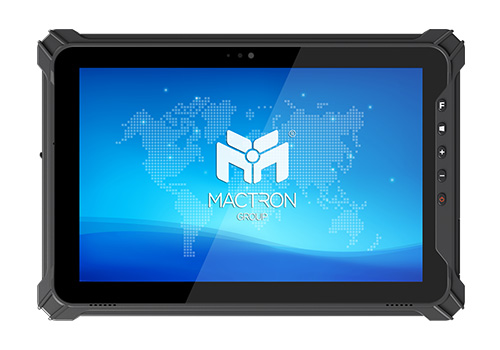

Check out
MACTRON GROUP(MTG)’s
MAS Series/
MAA Series
Series. Our mobile tablets are all equipped with Bluetooth 5.0
and Bluetooth 5.2, which can meet your work environment and
connected devices.