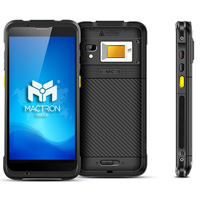
Simplify Employee Management with Fingerprint Scanners
Fingerprint scanners have become vital to modern life,
effortlessly identifying individuals with a single touch.
Exploring the technology behind them and their potential
applications reveals their significant impact on various aspects
of our daily lives.
Fingerprint Scanner
Fingerprints are distinctive friction ridge patterns on fingers,
that serve as durable and intricate identifiers. Fingerprint
scanners, crucial components of Biometrics security systems,
utilize diverse recognition technologies in police stations,
security sectors, smartphones, and mobile devices. These scanners
capture and analyze fingerprint data using unique principles and
sensor systems, guaranteeing precise identification and
authentication. Here's an overview of each type's operating
principle:
Optical:
Capacitive fingerprint recognition relies on the electrical
properties of human skin. A sensor array detects electrical
variances between ridges and valleys on the fingerprint's surface.
When a finger touches the sensor, capacitance at each pixel is
gauged, forming a unique fingerprint image from capacitance
variations.
Advantages:
-
Cost-effective: Optical scanners provide a budget-friendly
alternative compared to other types.
-
Ideal for essential security: They effectively fulfill basic
authentication needs.
-
User-friendly: They typically offer an intuitive experience
and straightforward setup process.
Challenges:
-
Lower resolution: Optical scanners may have reduced
resolution, resulting in less accurate scans compared to other
types.
-
Susceptible to environmental factors: Wet, dry, or aged
fingers may pose issues with image capture due to variations
in reflective properties.
Capacitive:
Capacitive fingerprint recognition relies on the electrical
properties of the human skin. A capacitive sensor array detects
the electrical differences between ridges and valleys on the
fingerprint's surface. When a finger is placed on the sensor, the
capacitance at each pixel is measured, creating a unique
fingerprint image based on the variations in capacitance.
Advantages:
-
Higher security: Capacitive scanners are generally more secure
compared to optical scanners.
-
Better accuracy: They provide higher-resolution scans, leading
to more accurate authentication.
-
Less affected by external factors: They are less affected by
dirt, moisture, or lighting conditions.
Challenges:
-
Higher cost: Capacitive scanners are typically more expensive
due to their advanced technology.
-
Limited to certain materials: They work best with conductive
materials, limiting the types of surfaces they can be
integrated into.
Ultrasonic:
Ultrasonic fingerprint recognition utilizes ultrasonic waves to
generate a 3D image of the fingerprint's subsurface features. A
transducer emits ultrasonic waves that penetrate the skin and
bounce off unique fingerprint characteristics like ridges and
pores. The sensor captures these reflections, forming a detailed
3D fingerprint image for authentication.

Advantages:
-
Highly secure: Ultrasonic scanners provide heightened security
by capturing detailed 3D fingerprint images.
-
Spoofing resistance: They are less susceptible to spoofing
compared to optical and capacitive scanners.
-
Works through materials: Ultrasonic scanners can penetrate
thin materials like glass or plastic, offering design
flexibility.
Challenges:
-
Cost: Ultrasonic scanners are often pricier due to their
advanced technology.
-
Power consumption: They may drain more power, impacting
battery life in mobile devices.
-
Complexity: The technology behind ultrasonic scanning is more
complex, which may result in higher maintenance costs and
potential integration challenges.
Advantages of using fingerprint scanner in Industrial PC

Advantages of Fingerprint Scanners in Industrial PCs:
-
Enhanced Security: Fingerprint scanners offer Biometrics
authentication, difficult to spoof, ensuring higher security
compared to passwords.
-
Convenience and Efficiency: Users find fingerprint
authentication convenient, eliminating the need for password
memorization or physical tokens, thereby speeding up login
processes.
-
Reduced Risk of Unauthorized Access: Fingerprint
authentication limits access to authorized personnel only,
minimizing the risk of unauthorized entry, data breaches, and
sabotage.
-
Integration with Access Control Systems: Fingerprint scanners
seamlessly integrate with access control systems, enabling
effective enforcement of security policies, user access
tracking, and audit trail maintenance.
-
Compliance with Regulations: Fingerprint authentication helps
organizations comply with industry-specific data security,
privacy, and access control regulations, enhancing regulatory
compliance.
Overall, fingerprint scanners in Industrial PCs offer robust
security, convenience, and compliance benefits, enhancing
industrial authentication systems' effectiveness.
The choice of fingerprint scanner depends on security
requirements, budget, environmental conditions, and intended use.
Each type has unique strengths and weaknesses, necessitating
careful consideration during selection.
Check out
MACTRON GROUP(MTG)’s
MCA0556
&
MCA0806
products. Both of them supports capacitive fingerprint, and
MCA0806 support both capacitive and optical fingerprint module.
They will become powerful tools to help you manage employee
identification and information security.