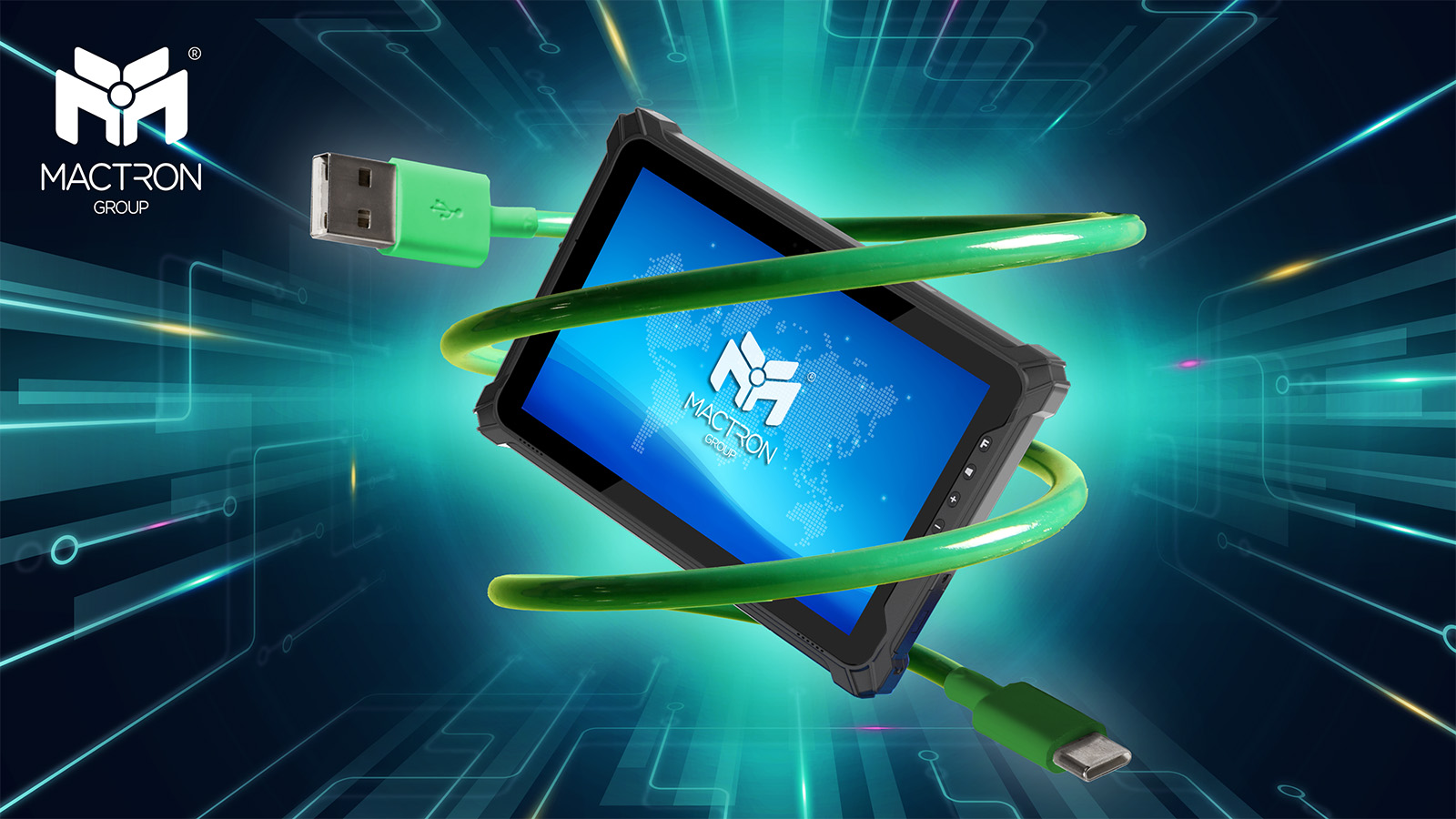
Evolution and Benefits of USB Type-C for Rugged Mobile Tablet PC
In recent years, USB Type-C has become the universal standard for
modern devices, including smartphones, laptops, tablets and other
electronics. However, one of its most impactful applications is in
rugged tablets, where reliability, durability, and flexibility are
important. Rugged tablets are specifically designed for use in
harsh environments such as industrial production line, field
services, and some of military operations. In these challenging
applications and environments, the advanced features of USB Type-C
offer significant advantages that enhance both functionality and
performance.
The Evolution of USB Leading to USB Type-C

The development of USB Type-C marks a significant evolution in the
Universal Serial Bus (USB) standard, which was initially
introduced in the 1990s to standardize connections between
computers and peripherals. Over the years, USB technology has
advanced to accommodate the increasing demands of modern devices
for faster data transfer, higher power delivery, and more
versatile connectivity. USB Type-C, introduced in 2014, represents
a response to these growing needs.
-
Early USB Standards:
-
USB 1.0 and 1.1 (1996-1998): The first USB standard was
created to simplify the connection between computers and
peripherals such as keyboards, mouse, and printers. It
provided speeds of 12 Mbps.
-
USB 2.0 (2000): This version brought a significant
upgrade, increasing data transfer rates to 480 Mbps. It
became widely used for external storage devices, camera,
and other peripherals. However, limitations started to
appear as devices became more powerful and required faster
data transfer.
-
USB 3.0 and 3.1 (2008-2013)
-
USB 3.0 (2008): With the advent of HD video and other
data-intensive applications, USB 3.0 introduced the data
transfer speeds of up to 5 Gbps. It became a major step
forward, but it still retained the larger, non-reversible
USB-A connector.
-
USB 3.1 (2013): This update increased speeds to 10 Gbps
(also known as SuperSpeed+) and introduced improved power
delivery. But it still used the older connectors.
These advancements in speed and power capabilities
highlighted a need for a more efficient, future-proof
connector that could handle the growing demands for faster
data transfer, greater power output, and seamless usability.
This led to the introduction of USB Type-C.
-
USB Type-C (2014)
USB Type-C was developed by the USB
Implementers Forum (USB-IF) which aim to standardize and
evolve USB technology. USB Type-C was released in 2014 and
designed as a universal connector that would address many of
the limitations of earlier USB standards.
Key Features of USB Type-C
-
Reversible Design: Unlike its predecessors (USB Type-A,
Micro-USB), the USB Type-C connector is fully reversible,
meaning users can plug it in either way without worrying about
orientation.
-
Compact Size: USB Type-C is much smaller than USB Type-A and
Type-B connectors, making it ideal for modern, slim devices
like smartphones, laptops, and tablets.
-
High Data Transfer Rates: USB 3.1 (the first standard that
introduced USB TYPE-C) supports speeds of up to 10 Gbps. Later
revisions like USB 3.2 and USB4 offer even faster speeds, up
to 40 Gbps. Power Delivery (PD): USB Type-C supports the USB
Power Delivery standard, allowing for significantly higher
power output (up to 100W). This enables it to charge larger
devices such as laptops, monitors, and even external
batteries.
-
Video and Audio Transmission: USB TYPE-C can also carry video
signals, supporting standards like DisplayPort and HDMI.
-
Universal Adoption: USB TYPE-C has been adopted across a wide
range of devices including smartphones, laptops, tablets,
gaming consoles, and accessories. It is seen as a standard for
the future electronics.
Why USB Type-C is Ideal for Rugged Tablets…

Durability and Reversibility
Rugged tablets are often used in demanding conditions where quick
and reliable connections are crucial. The reversible design of USB
Type-C means users don’t have to worry about the direction of
plugging in cables, reducing wear and tear on ports, which is
critical in environments where dust, moisture, and impact are
common.
Fast Data Transfer for Critical Operations
Rugged tablets are often used to transfer large amounts of data,
whether it’s for inventory management in a warehouse or real-time
field data collection. USB Type-C supports high-speed data
transfer protocols like USB 3.2 and USB4, enabling data rates of
up to 40 Gbps. This allows users can quickly sync large files,
transfer data, or connect external devices ensuring that workflows
are not disrupted by slow transfer speeds.
Power Delivery (PD) for Charging
The Power Delivery feature of USB Type-C is particularly useful
for rugged tablets, which are often used in mobile, outdoor, or
remote locations. With up to 100 watts of power delivery, Type-C
can efficiently charge rugged tablets in the field, where downtime
can be costly. Additionally, USB PD allows for intelligent power
negotiation, ensuring that the device receives the appropriate
amount of power, extending battery life and preventing overheating
during long usage periods.
Enhanced Connectivity with Peripherals
Alternate Modes of USB Type-C allows rugged tablets to output
video and audio via a single port.
Future-Proof Design for Evolving Workflows
As technology continues to advance, the demands on rugged tablets
grow. USB Type-C is future-proof, supporting backward
compatibility with legacy USB devices while also accommodating
emerging technologies. For industries like manufacturing,
logistics, and healthcare, where rugged tablets play a critical
role, this ensures that the devices can continue to integrate with
new tools and systems over time.
Conclusion: The USB Type-C Advantage in Rugged Tablets
The combination of durability, high-speed data transfer, power
delivery, and flexibility of USB Type-C makes it a perfect match
for rugged tablets. These devices are essential for professionals
working in extreme environments, and the advanced capabilities of
USB Type-C help ensure they perform reliably, regardless of the
conditions. As rugged tablets continue to evolve, USB Type-C will
remain the basement of their design of their design, enhancing
their ability to meet the demands of modern industrial and field
applications.
Check out
MACTRON GROUP (MTG)’s
MTP Series. Our
MAS
and
MAA
features an Intel Processor and ARM SoC, providing a reliable,
secure and remotely manageable computing systems. It can meet all
your business needs, optimize job procedures, and save the cost of
manageability. Contact
MACTRON GROUP
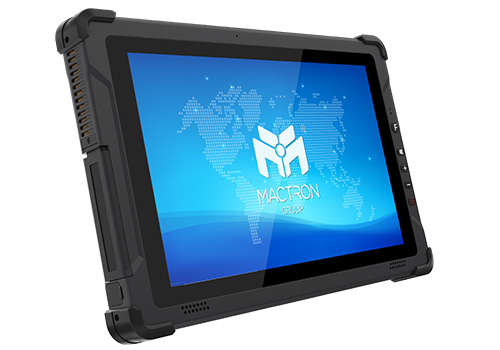
for more information.